
Did You Know? The Common Coral Tree (Erythrina lysistemon)
A spectacular indigenous tree with beautiful red flowers – but is it the right choice for your garden?
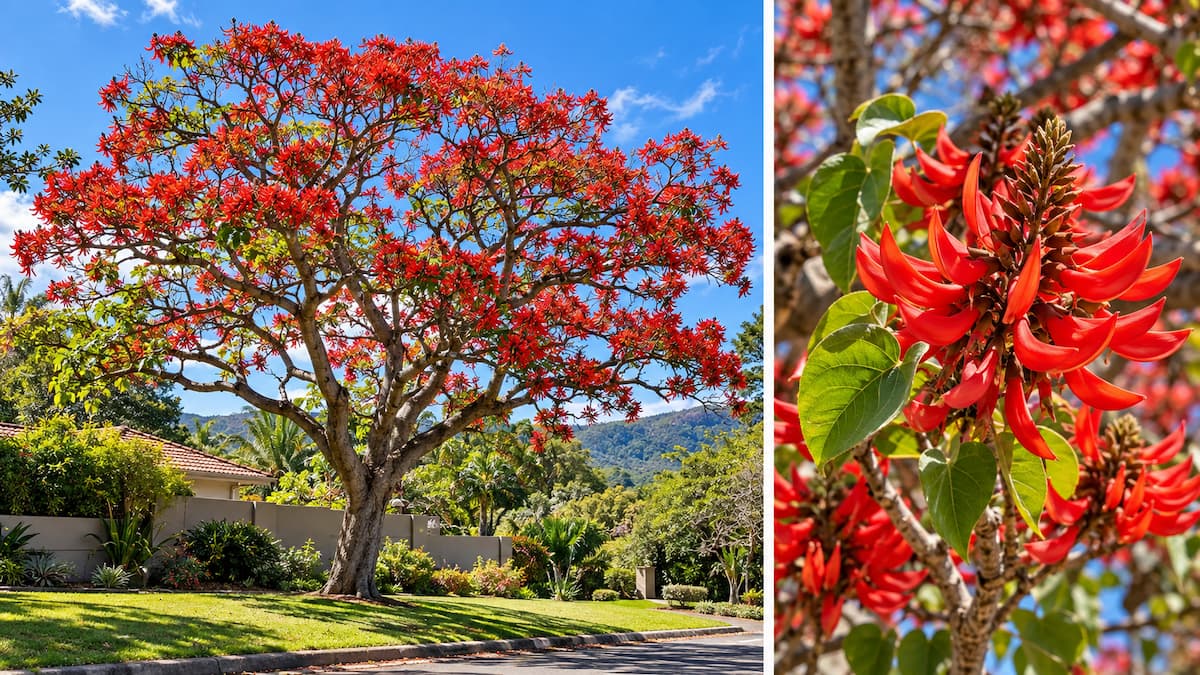
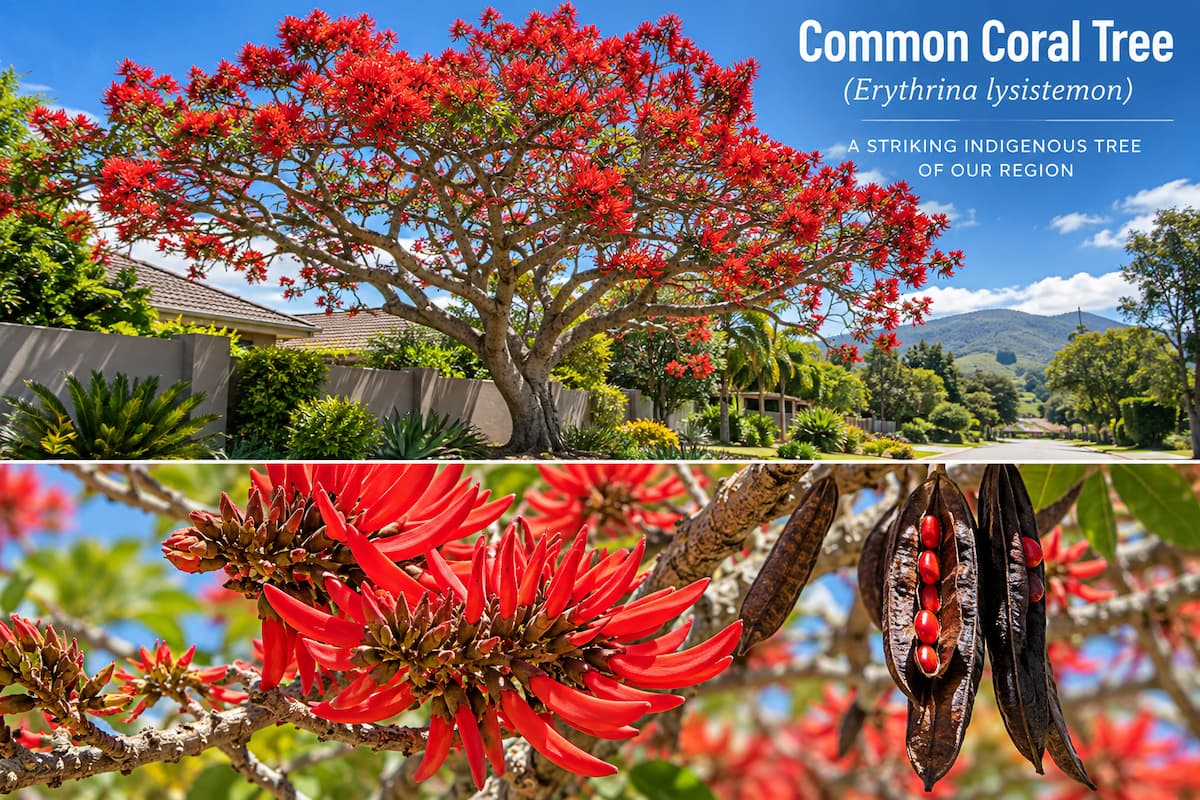
Few indigenous South African trees are as eye-catching as the Common Coral Tree (Erythrina lysistemon). Its brilliant scarlet flowers announce the arrival of spring, while its broad, spreading crown provides welcome shade during our hot Limpopo summers.
Commonly known as the Koraalboom in Afrikaans or the Lucky Bean Tree, this fast-growing species is found naturally in Limpopo and several other South African provinces.
But there is something every homeowner should know: a beautiful tree planted in the wrong place can become an expensive problem.
In this week's Rautenbach Holdings Tree Facts feature, we take a closer look at the Coral Tree's growth, root system, planting requirements and ongoing maintenance.
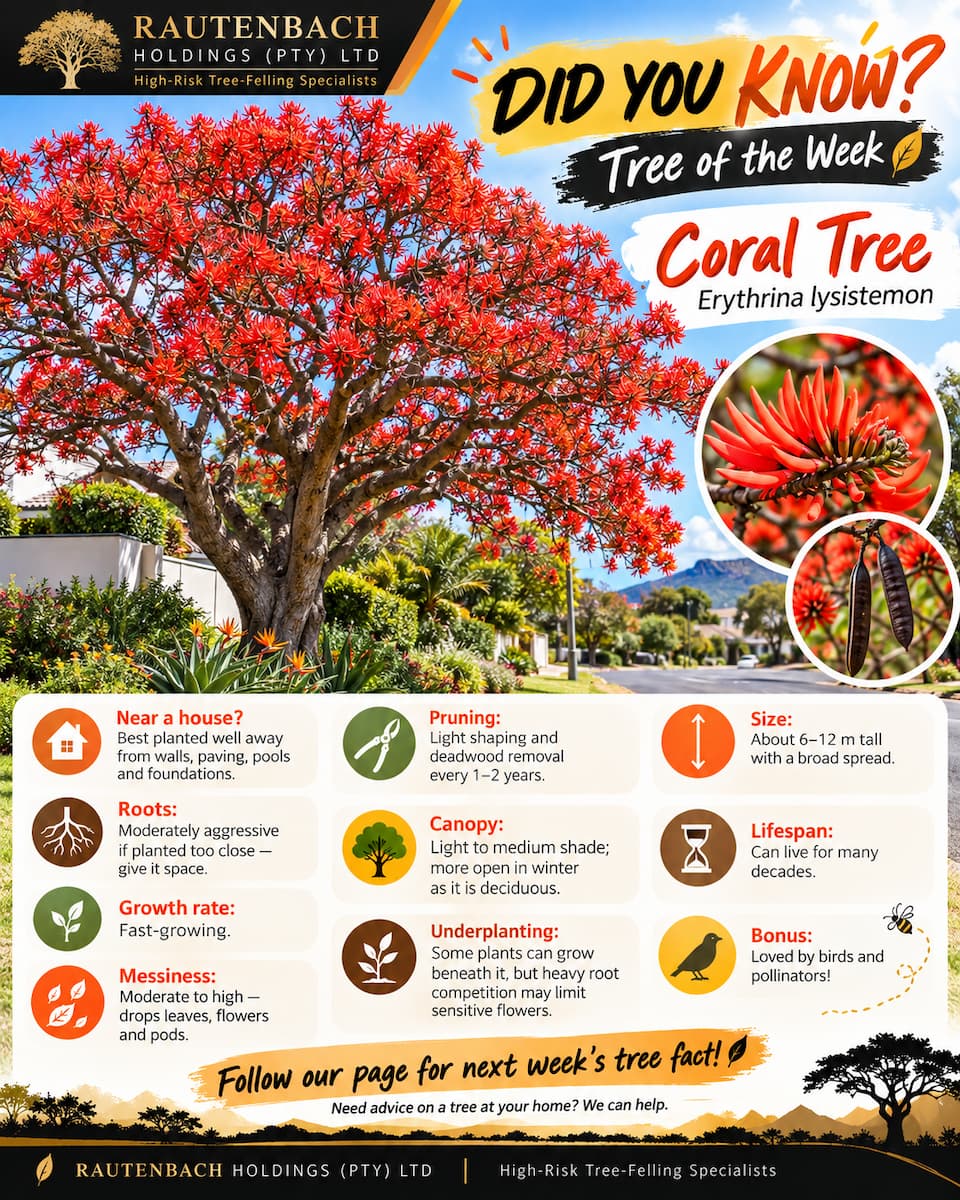
🌳 1. Tree at a Glance
2. How Aggressive Are the Roots?
This is one of the most important considerations before planting a Coral Tree.
The Common Coral Tree develops a vigorous, spreading root system that requires plenty of room.
As the tree matures, its expanding roots can lift paving, interfere with landscaping and place pressure on nearby structures, particularly where there is inadequate space.
Potential problem areas include:
Not every Coral Tree will cause structural damage. The actual risk depends on the available growing space, soil conditions, root development and the condition of nearby structures.
Our advice: Avoid planting a Coral Tree close to buildings or hard landscaping. A clearance of at least 5 m is a useful general starting point, with greater distances preferable where space allows.
A narrow flower bed between two walls is not a suitable location for a tree that can develop such an extensive root system.
3. Can You Plant a Coral Tree Near Your House?
Although a Coral Tree can be an attractive feature in a large garden, it is generally unsuitable for planting immediately alongside a house.
It is important to consider both the underground root system and the space the mature canopy will eventually occupy.
A young tree might look perfectly manageable, but its size and spread can change considerably as it matures.
Branches may eventually extend over a roof, driveway or neighbouring property, while the roots continue expanding underground.
Our advice: Choose a spacious, open position where the tree can develop naturally without needing repeated, heavy pruning to keep it away from buildings.
If your property is small or surrounded by boundary walls, a smaller indigenous species may be more appropriate.
4. How Fast Does a Coral Tree Grow?
The Common Coral Tree is a fast-growing species under favourable conditions.
With sufficient sunlight, suitable soil and adequate water during its establishment, it can develop into a substantial tree relatively quickly.
Mature trees commonly reach heights of approximately 6–10 m, although some specimens can reach 12 m.
Their spreading crowns can also become surprisingly wide.
This makes the Coral Tree attractive to homeowners looking for relatively quick shade, but it also means the tree can outgrow its intended planting space sooner than expected.
Our advice: Always plan for the trees mature size, not the size of the young tree you purchase from the nursery.
5. How Messy Is a Coral Tree?
If you enjoy a perfectly neat garden throughout the year, a Coral Tree may require more cleaning than you expect.
If you enjoy a perfectly neat garden throughout the year, a Coral Tree may require more cleaning than you expect.
It also produces seasonal litter from its flowers, seed pods and bright red seeds.
You can expect:
The amount of litter depends on the tree's size and the season, but a large specimen can create a considerable amount of garden waste.
Fallen material can also accumulate in gutters, on roofs and around swimming pools.
Our advice: Avoid planting a Coral Tree directly over swimming pools, frequently used parking areas or locations where falling debris would create an ongoing maintenance problem.
6. How Dense Is the Canopy, and Will Flowers Grow Underneath?
One of the Coral Tree's attractive characteristics is its seasonal canopy.
During summer, its spreading branches and foliage provide useful shade. During winter, the tree loses its leaves, allowing considerably more sunlight to reach the ground.
The density of the canopy varies according to the tree's age, growing conditions and natural structure.
But can you grow a beautiful flower garden underneath it?
Yes, provided you choose appropriate plants and manage the growing conditions.
The main challenges are competition from the tree's roots for water and nutrients, as well as the reduced sunlight during summer.
Shade-tolerant plants and suitable groundcovers may perform well, while plants requiring uninterrupted, direct sunlight are less suitable.
The additional winter sunlight can benefit plants that grow or flower during the cooler months.
Our advice: Select plants according to the actual sunlight and moisture available beneath your tree. Avoid damaging established roots when preparing flower beds.
7. How Often Should a Coral Tree Be Pruned?
A Coral Tree does not automatically need heavy pruning every year.
The correct maintenance schedule depends on its age, structure, location and overall condition.
Young trees may benefit from selective structural pruning to encourage a balanced crown and appropriate branch development.
Mature trees should be inspected regularly for dead, damaged, poorly attached or potentially dangerous branches.
Particular attention should be paid to branches extending over buildings, vehicles, walkways and neighbouring properties.
Coral Trees can also be affected by wood-boring insects, which may cause branch dieback. Dead or damaged branches should be assessed and dealt with appropriately.
Our advice: Inspect your tree at least once a year and arrange professional pruning when its condition or surroundings justify it.
Avoid unnecessary topping or severe pruning. Proper selective pruning is generally preferable to repeatedly cutting back large branches.
8. How Long Can a Coral Tree Live?
A healthy Common Coral Tree can survive for many decades, although there is no reliable fixed lifespan that applies to every specimen.
Its longevity depends on environmental conditions, available growing space, disease, pests, physical damage and ongoing maintenance.
Trees that are planted in suitable locations and allowed to develop naturally have a better opportunity to remain healthy over the long term.
A tree repeatedly subjected to root damage, severe pruning or unsuitable growing conditions may experience a much shorter useful lifespan.
Our advice: Good planning when planting a tree is just as important as caring for it once it is established.
9. Is the Coral Tree Suitable for the Tzaneen Climate?
Yes. The Common Coral Tree is indigenous to Limpopo and is well suited to many of the warmer parts of our region.
It generally prefers full sun and fertile, well-drained soil.
Although established specimens are fairly drought-tolerant, they benefit from water during dry summer periods.
Young trees require more attention while their root systems become established.
Coral Trees are sensitive to severe frost, so homeowners in cooler areas, particularly around Haenertsburg and higher-altitude locations, should consider their property's specific conditions before planting.
10. Did You Know? Interesting Coral Tree Facts
The Coral Tree is more than just a beautiful garden feature.
A favourite among birds
Its nectar-rich flowers attract birds and insects, making it a valuable addition to gardens where supporting local wildlife is a priority.
It flowers before its leaves appear
The spectacular red flowers often emerge while the branches are still bare, creating a striking display during late winter and early spring.
Its seeds are called lucky beans
The distinctive red seeds have traditionally been used as decorative objects and lucky charms.
However, the seeds contain toxic compounds and must never be eaten. Take particular care where young children or pets may encounter fallen seeds.
Its branches have natural prickles
The trunk and branches may have short, hooked prickles. These are worth remembering when working around the tree.
11. The Rautenbach Holdings Perspective: A Lesson from Aqua Park
We recently removed three palm trees and a Coral Tree from a property in Aqua Park, Tzaneen.
All four trees had been planted in a narrow flowerbed between a boundary wall and a retaining wall.
The trees had very limited space for their root systems to develop, and their continued growth posed a risk to the surrounding structures.
Removing the trees addressed the potential for further problems as they grew.
This project highlights an important principle that applies to many species:
The wrong planting location can turn a beautiful tree into a costly problem.
We are not against planting Coral Trees. They are beautiful indigenous trees that support local wildlife and can be wonderful additions to suitable properties.
However, we encourage homeowners to consider the tree's mature size, root development, maintenance needs and proximity to structures before choosing a planting location.
Sometimes professional pruning is sufficient to manage a tree safely. In other situations, particularly where the roots are affecting structures or there is insufficient room for continued growth, removal may need to be considered.
Every situation deserves an individual assessment.
12. Need Professional Tree Advice in Tzaneen?
Whether you need professional tree pruning, canopy reduction, a tree-risk assessment or high-risk tree removal, Rautenbach Holdings is here to help.
We provide professional tree-felling and related services throughout Greater Tzaneen, Haenertsburg, Letsitele, Modjadjiskloof, Phalaborwa and surrounding areas.
Our focus is on responsible tree management, the protection of your property and the safety of the people around it.
✅ Done the Rautenbach Holdings way: Removing danger where others won’t dare.
Join Us Next Week!
Every Wednesday, Rautenbach Holdings will feature another fascinating tree from our region.
Follow our Facebook page and explore our Tree Facts articles to learn more about the trees growing around our homes, gardens and communities.
Have a tree you'd like us to feature? Let us know!